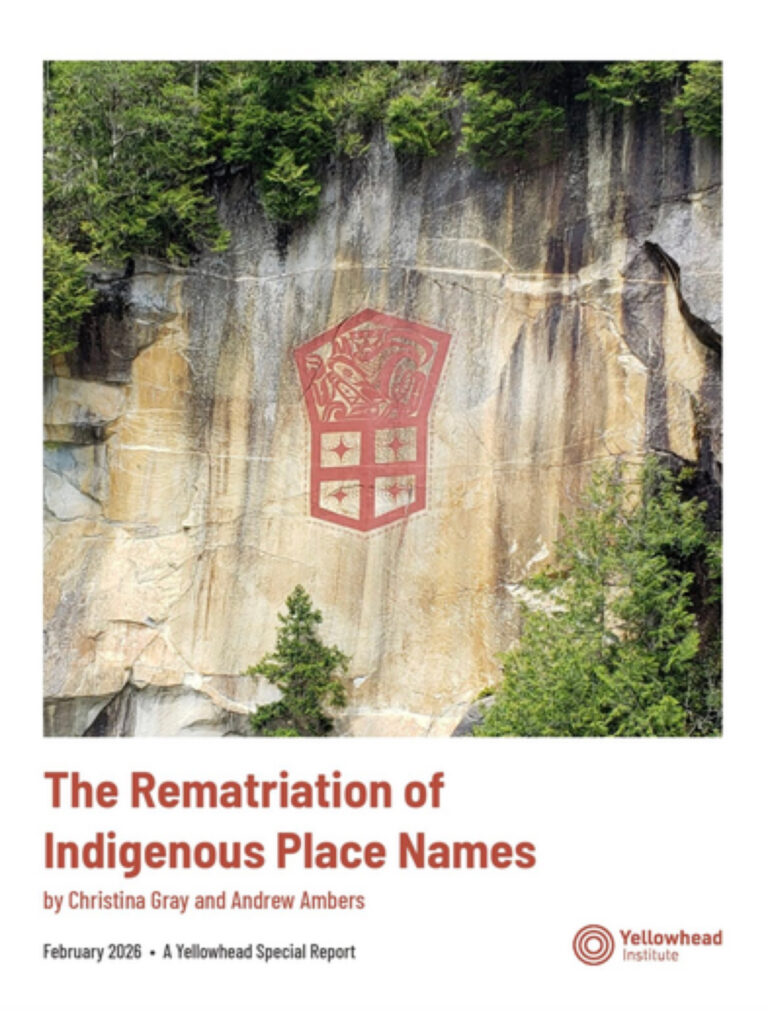
Artist: Marianne Nicolson, Kwakwa̱ka̱ʼwakw, Musgamakw Dzawada’enuxw Nations
“Indigenous Peoples’ choice to name and rename is deeply embedded in community-based decisions to reawaken responsibilities, rights, and jurisdiction. It is a process that is rooted in Indigenous legal orders.” – Christina Gray and Andrew Ambers
In The Rematriation of Indigenous Place Names (2026), Dene and Ts’msyen scholar Christina Gray and ‘Namgis and Ma’amtagila scholar Andrew Ambers of the Kwakwa̱ka̱ʼwakw Peoples illustrate how the rematriation of Indigenous place names can revitalize Indigenous law and governance. The report explains that rematriation “inscribes practices of recovery and return to the relationships between Indigenous lands, laws, governance, values, and cultures” (p. 6). A particularly important contribution of the report is its emphasis on re-establishing Indigenous women’s leadership and matriarchal authority. Gray and Andrew show how rematriation centres Indigenous women, matriarchs, Two-Spirit and gender-diverse people while revitalizing Indigenous gender norms and restoring matriarchal authority and responsibility embedded within kinship networks, land, and histories. The authors identify three interconnected practices that guide the rematriation of Indigenous place names:
“Truth-telling” is a legal responsibility that involves correcting colonial histories and harms and restoring accurate accounts of Indigenous relationships with land. It is closely associated with good governance and integrity.
“Witnessing” is a relational responsibility that requires individuals and communities to record important processes, transactions, and historical narratives. By recalling what has been witnessed when called upon to do so, witnessing helps uphold truth, political accountability, and collective well-being.
“Gifting” recognizes that Indigenous place names are not simply labels but gifts that carry knowledge, responsibilities, and relationships. As Gray and Andrew explain, “gifting a place name can be understood as placing Indigenous laws on the land” (p. 17). Through this process, responsibilities are assigned and affirmed among Indigenous Peoples, governments, and the public, while honouring the histories and relationships that give meaning to place.
To learn more about the rematiration of Indigenous place names, please see:
The Rematriation of Indigenous Place Names (Gray & Ambers, 2026).
What is in a place name (how how do you change it)?