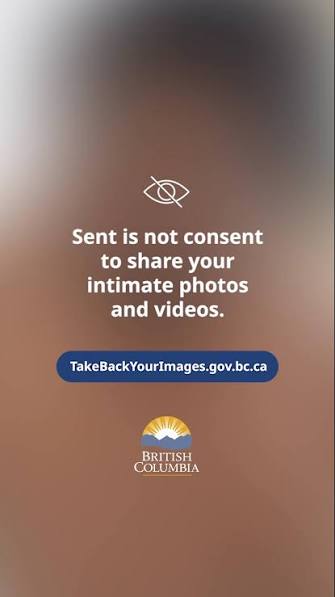

(Image Source: Take Back Your Images – Province of British Columbia)
Have you ever had an intimate image posted online without your consent? Or shared an intimate photo without knowing if the person/s shown consented? Do you know someone who has created a fake image of someone at school and posted it online?
Youths, teens, and young adults regularly share their lives on social media, including sharing intimate images. These images might be “real,” but also include AI-generated deep fakes. In Canada in 2024, cybertip.ca received 436 reports for non-consensual distribution of intimate images. Those numbers increased to 527, with 19 of those images involving AI.
In 2023, the Province of BC introduced the Intimate Images Protection Act with the clear message that circulating or threatening to distribute intimate images is an act of sexualized violence. In 2026, the BC Government strengthened the Act by increasing the damage limit from $5k to $75k for those whose intimate images had been posted online.
Before you post or share an intimate image, consider the below facts gathered by the not-for-profit agency Children of the Street. Often leading to bullying, suspensions, and sometimes suicide, these numbers represent real and devastating harm to youth across Canada:
Did You Know……
K-12 Teacher Resources:
Canadian Centre for Child Protection – Youth Non-Consensual Distribution of Intimate Images: A Guide for Schools (Free PDF): https://protectchildren.ca/en/order/product/454:en/
Children of the Street: https://www.childrenofthestreet.com/youth/stop-the-share/
Criminal Code of Canada, s.162.1 (1) & 163.1 (1): https://laws-lois.justice.gc.ca/eng/acts/C-46/page-26.html#docCont
Cybertip.ca – Online Harms: Intimate Images: https://www.cybertip.ca/en/online-harms/intimate-images/
Intimate Images Protection Act: https://www.bclaws.gov.bc.ca/civix/document/id/complete/statreg/23011#section23
Province of British Columbia – Take Back Your Images: https://takebackyourimages.gov.bc.ca/