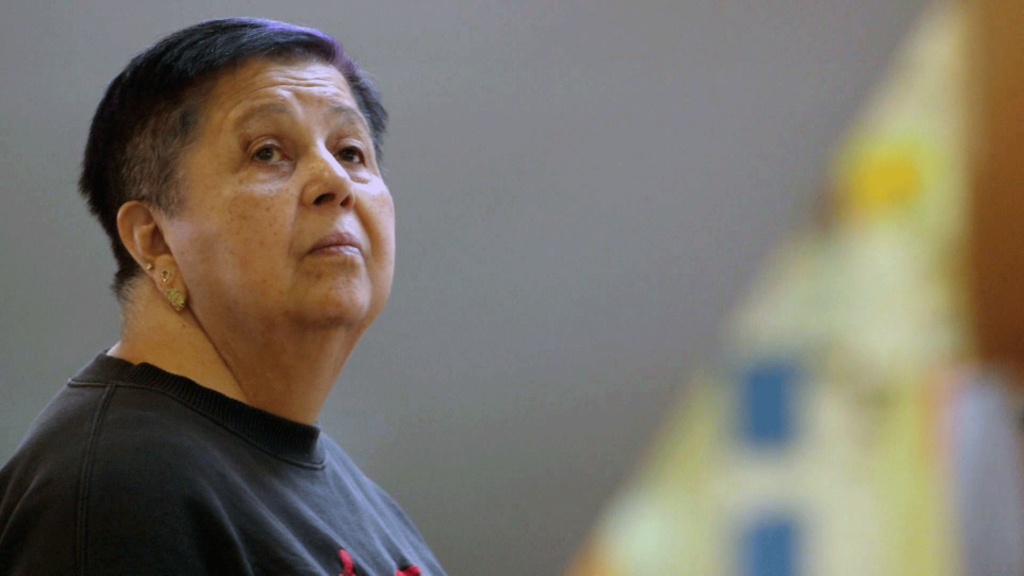

Part 3: Who is Sharon McIvor?
Image taken from: https://globalnews.ca/news/4836380/founder-canada-first-healing-lodge-csc-vision/
Sharon McIvor, a Secwépemc woman from the Lower Nicola Indian Band, is a lawyer, a long-time Indigenous rights advocate, and a Professor of Indigenous Studies at the Nicola Valley Institute of Technology. She has been recognized by Canada’s Governor General for her decades-long legal and advocacy work challenging gender discrimination in the Indian Act and advancing equality for Indigenous women and their descendants.
Before 1985, McIvor lost her Indian status because she married a non-status man – a consequence that did not apply to Indigenous men who married non-status women. Although McIvor regained status rights in 1985, after the passing of Bill C-31, she remained unable to pass those rights on to her children in the same way that a man with status could, exposing how the amended legislation continued to privilege male lines of descent while discriminating against Indigenous women and their families.
Through McIvor v. Canada, she challenged these provisions as a violation of equality rights under the Canadian Charter of Rights and Freedoms, arguing that the legislation continued to privilege patriarchal descent lines despite appearing to be a reform. Her case, filed in 1989, faced prolonged government delay and procedural barriers before finally being heard in 2006, illustrating the endurance required to sustain Indigenous rights litigation over time. In 2007, the British Columbia Supreme Court ruled in her favour, finding that key provisions of the Indian Act were discriminatory, which led to partial legislative change through Bill C-3 in 2011. However, McIvor has continued to argue that the reforms did not fully remove gender-based inequities, particularly the “second-generation cut-off” which still affected her descendants and many other Indigenous families. She later brought her case to the United Nations Human Rights Committee, which confirmed in 2019 that Canada continued to discriminate against Indigenous women and their descendants.
McIvor’s activism demonstrates that discrimination in the Indian Act affects not only legal status but also family relationships, cultural belonging, the rights of Indigenous women and their descendants and the intergenerational continuity of Indigenous families and Nations.
Want the latest update on the second-generation cut-off? A Conservative MP says 4,000 letters have been sent urging Prime Minister Carney to amend Indian Act status rules.
Sources referenced in this post:
https://www.caut.ca/bulletin/interview-sharon-mcivor/
https://www.scc-csc.ca/cases-dossiers/search-recherche/33201/
https://femlaw.queensu.ca/sites/flswww/files/uploaded_files/McIvorIABackground2009.doc
https://www.rcaanc-cirnac.gc.ca/eng/1540405608208/1568898474141#_Bill_C-31_and