More than 40 years later, the “2nd-generation cut-off” continues to impact Indigenous women and their descendants under the Indian Act.
Part 1: What is the 2nd-generation cut-off?
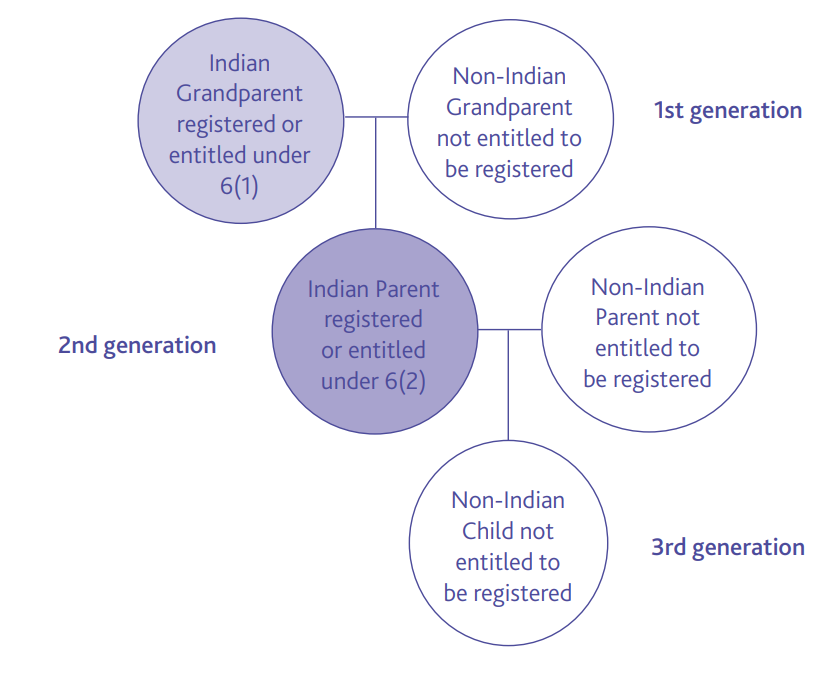
The “2nd-generation cut-off” is a rule in the Indian Act that limits how Indian Status is passed down across generations.
In simple terms, if a person with Indian Status has a child with a non-status partner, that child may have status but may not be able to pass it onto their own children. After two consecutive generations of parenting with non-status partners, Indian Status can be lost.
This rule produces ongoing gendered and intergenerational inequity.
Before 1985, Indigenous women who married non-status men lost their status, while non-Indigenous women who married status men gained it.
Bill C-31 (1985) was introduced to address this discrimination, and restructured Indian Status into two categories:
- 6(1): can pass status regardless of partner’s status
- 6(2): can only pass status if the other partner also has Indian status
This means a person with 6(2) status who has a child with a non-status partner may have a child who cannot pass status on. This is the “second-generation cut-off.”
To find out more, see: https://www.afn.ca/wp-content/uploads/2020/01/06-19-02-06-AFN-Fact-Sheet-Second-Generation-cut-off-final-revised.pdf
Source: Assembly of First Nations
To learn more, follow this page. Part 2 explores how this rule continues to affect Indigenous women and families.